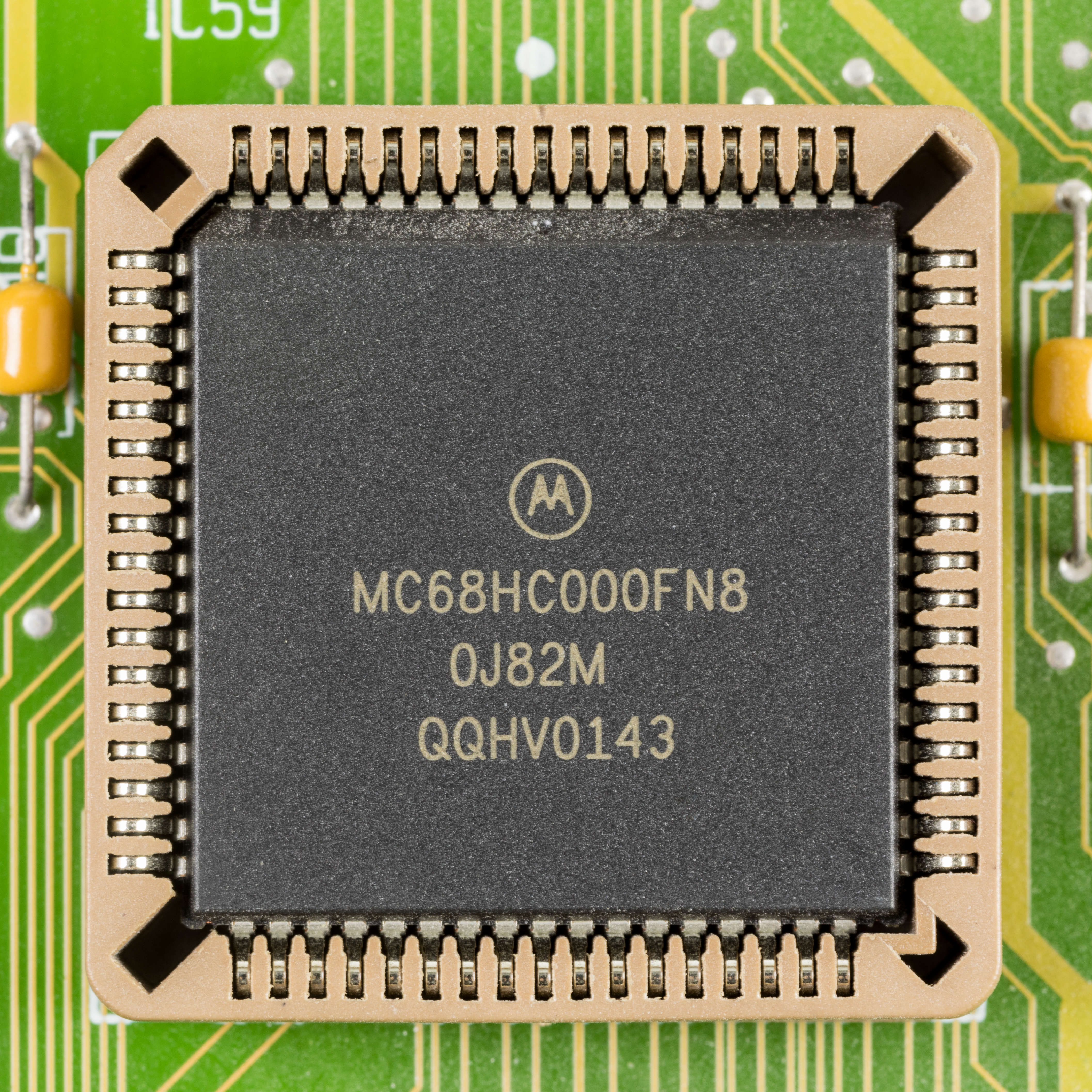
The chip itself
jsr <subroutine>: (J)ump (T)o (S)ubroutine -
calls a function.bsr <subroutine>: (B)ranch (T)o (S)ubroutine -
pushes the next instruction to the stack and calls a function.
rts is only after a branch.bra <subroutine>: (BR)anch (A)lways - jump
forwards or backwards.
bra.s: (BR)anch (A)lways (S)hort - jump up to 126 bytes
forwards/backwards.bra.w: (BR)anch (A)lways (W)ord - jump up to 32766
bytes forwards/backwards.Note that branch instructions are faster and smaller in memory, but
limited in how far they can jump. jsr can jump
anywhere.
move.(w/l) <src>, <dst>: (Move) - move from
src to dst.movea.(w/l) <src>, AR: (Move) (A)ddress - move
src to address register.cmp: (C)o(mp)arison - sets flags after a
comparison.bcc: lets you branch on a compare.lea <src> <dst>: (L)oad (E)ffective
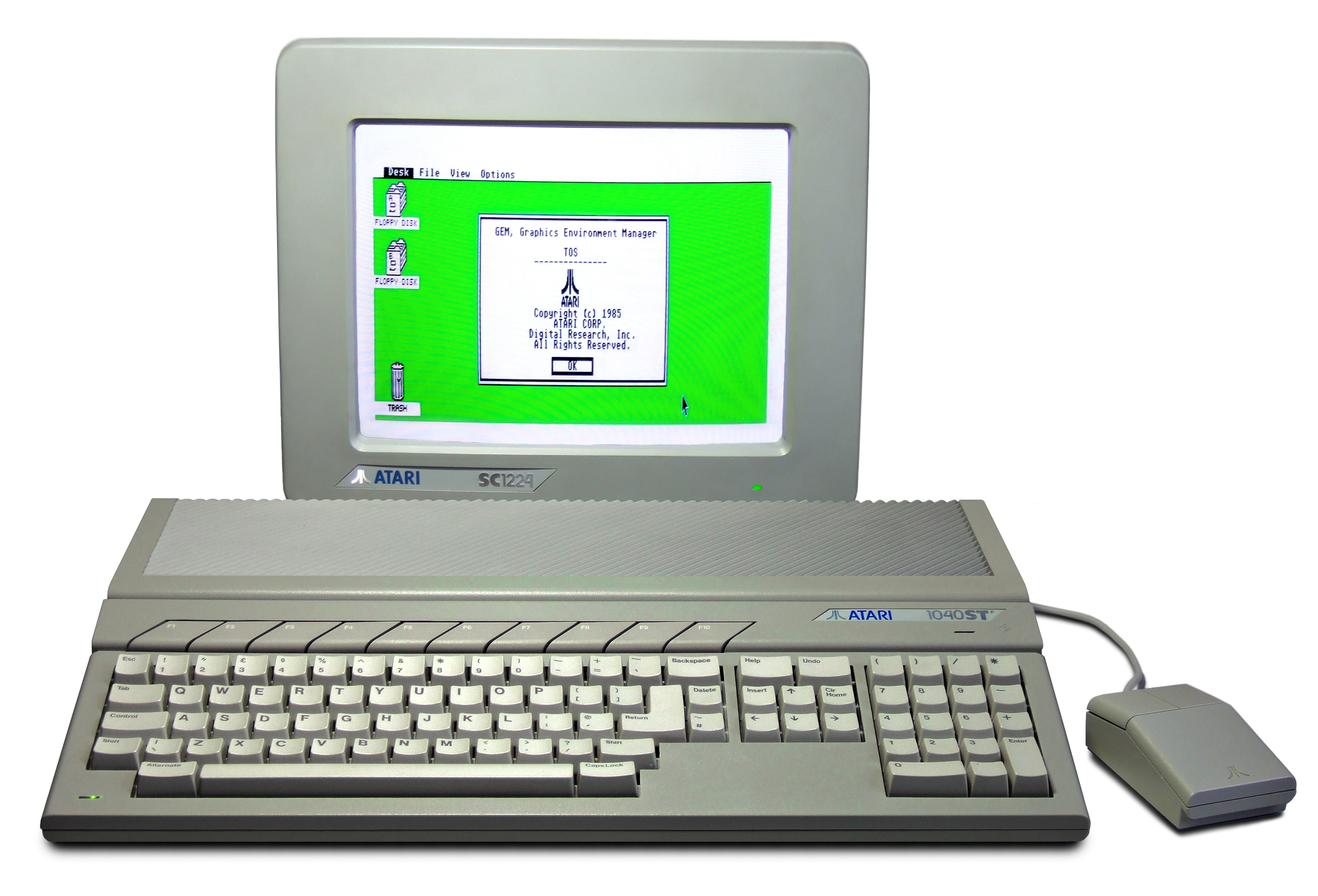
(A)ddress - Load a given address and place in dst.move.w #18,-(sp)addq.l #2,spThere are two emulators I’ve used.
These can run any kind of OS. I did not go with Linux (sorry) and ran AFROS, which is a TOS/Freemint compatible OS.
 Freemint is a open
source version of the MiNT operating system for Atari STs.
Freemint is a open
source version of the MiNT operating system for Atari STs.
As well, there’s a version of gcc with support for compiling to this
target. Thorsten Otto’s
website has gcc compilers built to target the
m68k-atari-mint-gcc. You can download these and start
compiling C code to run on your emulator.
I tried to compile Rust to this target too: My custom target
LLVM doesn’t compile to this target well. There’s some support for bare-metal (m68k-unknown-elf) but this doesn’t give you any user space. It also outputs ELF files which don’t run on our emulators out of the box anyway (they use a.out).
Stack trace that shows the issue in LLVM’s Instruction Selection:
/lib/librustc_driver-67dd58abd922ea00.so(+0x3c22f0f) [0x7faf1a822f0f]
/lib64/libc.so.6(+0x1a070) [0x7faf16a28070]
/lib/libLLVM.so.21.1-rust-1.93.0-nightly(+0x763347d) [0x7faf1443347d]
/lib/libLLVM.so.21.1-rust-1.93.0-nightly(+0x762d5fc) [0x7faf1442d5fc]
/lib/libLLVM.so.21.1-rust-1.93.0-nightly(+0x7629bd2) [0x7faf14429bd2]
/lib/libLLVM.so.21.1-rust-1.93.0-nightly(+0x7e9d192) [0x7faf14c9d192]
/lib/libLLVM.so.21.1-rust-1.93.0-nightly(_ZN4llvm16SelectionDAGISel17CodeGenAndEmitDAGEv+0x811) [0x7faf14c9ba9d]
/lib/libLLVM.so.21.1-rust-1.93.0-nightly(_ZN4llvm16SelectionDAGISel20SelectAllBasicBlocksERKNS_8FunctionE+0x1782) [0x7faf14e5fcc2]
/lib/libLLVM.so.21.1-rust-1.93.0-nightly(_ZN4llvm16SelectionDAGISel20runOnMachineFunctionERNS_15MachineFunctionE+0x3b6) [0x7faf14f5ea76]
/lib/libLLVM.so.21.1-rust-1.93.0-nightly(+0x8b7a6c9) [0x7faf1597a6c9]
/lib/libLLVM.so.21.1-rust-1.93.0-nightly(_ZN4llvm13FPPassManager13runOnFunctionERNS_8FunctionE+0xa17) [0x7faf14c2e3d7]
/lib/libLLVM.so.21.1-rust-1.93.0-nightly(_ZN4llvm13FPPassManager11runOnModuleERNS_6ModuleE+0x28) [0x7faf14c2d8fe]
/lib/libLLVM.so.21.1-rust-1.93.0-nightly(_ZN4llvm6legacy15PassManagerImpl3runERNS_6ModuleE+0x2b1) [0x7faf151f2671]
/lib/librustc_driver-67dd58abd922ea00.so(+0x64b31c5) [0x7faf1d0b31c5]
/lib/librustc_driver-67dd58abd922ea00.so(+0x64b2dfb) [0x7faf1d0b2dfb]
/lib/librustc_driver-67dd58abd922ea00.so(+0x64b4ff5) [0x7faf1d0b4ff5]
/lib/librustc_driver-67dd58abd922ea00.so(_RINvNtNtCsaEKiIOnD17M_3std3sys9backtrace28___rust_begin_short_backtraceNCINvXs0_Csalb8s5xQiG1_18rustc_codegen_llvmNtB1g_18LlvmCodegenBackendNtNtNtCsdw7PpDJEA2A_17rustc_codegen_ssa6traits7backend19ExtraBackendMethods18spawn_named_threadNCINvNtNtB2k_4back5write19spawn_thin_lto_workB1O_E0uE0uEB1g_+0x175) [0x7faf1d11fdf5]
/lib/librustc_driver-67dd58abd922ea00.so(+0x6253539) [0x7faf1ce53539]
/lib/librustc_driver-67dd58abd922ea00.so(+0x6258def) [0x7faf1ce58def]
/lib64/libc.so.6(+0x71f54) [0x7faf16a7ff54]
/lib64/libc.so.6(+0xf532c) [0x7faf16b0332c]libc to really understand the bits and bytes before
main.// How does our binary get argc and argv?
int main(int argc, char* argv[]) {
printf("hello world\n");
return 0; // what happens here?
}Does anyone know?
.text is where the instructions are for your
program.data is where initialized global/static variables go.
Don’t edit them..bss is where uninitialized global/static variables
go.OUTPUT_FORMAT(a.out-mintprg)
OUTPUT_ARCH(m68k)
ENTRY(_start)
SECTIONS {
/* Start at 0 for PRG (BFD will add the PRG header). */
. = 0;
/* --- TEXT + RO --- */
.text : ALIGN(2) {
KEEP(*(.text._start)) /* ensure _start first */
*(.text .text.*)
*(.rodata .rodata.*)
KEEP(*(.init))
KEEP(*(.fini))
}
/* --- DATA --- */
.data : ALIGN(2) {
*(.data .data.*)
*(.sdata .sdata.*)
*(.init_array .init_array.*)
*(.fini_array .fini_array.*)
}
/* --- BSS --- */
.bss (NOLOAD) : ALIGN(2) {
*(.bss .bss.*)
*(COMMON)
}
/* Strip sections not used on TOS */
/DISCARD/ : {
*(.comment) *(.note*) *(.eh_frame*) *(.stab*) *(.debug*) *(.gnu.*)
}
} .title "crt0.S for m68k-coff"
#define STACKSIZE 0x4000
/*
* Define an empty environment.
*/
.data
.align 2
SYM (environ):
.long 0
.align 2
.text
/*
* These symbols are defined in C code, so they need to always be
* named with SYM because of the difference between object file formats.
*/
.extern SYM (main)
.extern SYM (exit)
.extern SYM (hardware_init_hook)
.extern SYM (software_init_hook)
.extern SYM (atexit)
.extern SYM(__do_global_dtors)
/*
* These values are set in the linker script, so they must be
* explicitly named here without SYM.
*/
.extern __stack
.extern __bss_start
.extern _end
/*
* Set things up so the application will run. For historical reasons
* this is called 'start'. We set things up to provide '_start'
* as with other systems, but also provide a weak alias called
* 'start' for compatibility with existing linker scripts.
*/
.global SYM (start)
.weak SYM (start)
.set SYM (start),SYM(_start)
.global SYM (_start)SYM (_start):
/* See if user supplied their own stack (__stack != 0). If not, then
* default to using the value of %sp as set by the ROM monitor.
*/
movel IMM(__stack), a0
cmpl IMM(0), a0
jbeq 1f
movel a0, sp
1:
/* set up initial stack frame */
link a6, IMM(-8)
/*
* zero out the bss section.
*/
movel IMM(__bss_start), d1
movel IMM(_end), d0
cmpl d0, d1
jbeq 3f
movl d1, a0
subl d1, d0
subql IMM(1), d0
2:
clrb (a0)+
subql IMM(1), d0
jbpl 2b
/*
* call the main routine from the application to get it going.
* main (argc, argv, environ)
* we pass argv as a pointer to NULL.
*/
movel IMM (__FINI_SECTION__),(sp)
PICCALL SYM (atexit)
PICCALL __INIT_SECTION__
pea 0
PICPEA SYM (environ),a0
pea sp@(4)
pea 0
PICCALL SYM (main)
movel d0, sp@-That leaves one question: How does writing to the console work?
Freemint’s System Call for Fwrite
We can call this special trap #1 after loading our
arguments onto the stack and the OS will write for us.
pea       buf           ; Offset 8
move.l    count,-(sp)   ; Offset 4
move.w    handle,-(sp)  ; Offset 2
move.w    #64,-(sp)     ; Offset 0
trap      #1            ; GEMDOS
lea       $C(sp),sp     ; Correct stack
Translated to C:
static inline long trap_1_wwll(short n, short a, long b, long c) {
  register long retval __asm__("d0");
  short _a = (short)(a);
  long _b = (long)(b);
  long _c = (long)(c);

  __asm__ volatile("movl    %4,%%sp@-\n\t"
                   "movl    %3,%%sp@-\n\t"
                   "movw    %2,%%sp@-\n\t"
                   "movw    %1,%%sp@-\n\t"
                   "trap    #1\n\t"
                   "lea %%sp@(12),%%sp"
                   : "=r"(retval)                       /* outputs */
                   : "g"(n), "r"(_a), "r"(_b), "r"(_c)  /* inputs  */
                   : "d1", "d2", "a0", "a1", "a2", "cc", "memory" /* clobbered */
                  );
  return retval;
}fwriteThis code:
size_t fwrite(const void *ptr, size_t size, size_t nmemb, FILE *stream) {
  if (size == 0 || nmemb == 0)
    return 0;

  size_t total_bytes = size * nmemb;
  long ret = Fwrite(stream->handle, total_bytes, ptr);
  if (ret <= 0)
    return 0;

  return ret / size;
}
Turns into this:
$ m68k-atari-mint-objdump -dr build/objs/stdio/fwrite.o

build/objs/stdio/fwrite.o:     file format a.out-zero-big

Disassembly of section .text:

00000000 <_fwrite>:
   0:   48e7 3c20       moveml %d2-%d5/%a2,%sp@-
   4:   262f 001c       movel %sp@(28),%d3
   8:   202f 0020       movel %sp@(32),%d0
   c:   4a83            tstl %d3
   e:   6608            bnes 18 <.L2>

00000018 <.L2>:
  18:   4a80            tstl %d0
  1a:   67f4            beqs 10 <.L4>
  1c:   206f 0024       moveal %sp@(36),%a0
  20:   2810            movel %a0@,%d4
  22:   2f00            movel %d0,%sp@-
  24:   2f03            movel %d3,%sp@-
  26:   4eb9 0000 0000  jsr 0 <_fwrite>
  28:   32              ___mulsi3          # what the
  2c:   508f            addql #8,%sp
  2e:   2a2f 0018       movel %sp@(24),%d5 # Here's the syscall
  32:   2f05            movel %d5,%sp@-    # We load the buffer
  34:   2f00            movel %d0,%sp@-    # Then the length
  36:   3f04            movew %d4,%sp@-    # then the handle
  38:   3f3c 0040       movew #64,%sp@-    # Then #64, syscall for fwrite
  3c:   4e41            trap #1            # trap
  3e:   4fef 000c       lea %sp@(12),%sp   # correct the stack
...__mulsi3?$ m68k-atari-mint-objdump -D /usr/lib64/gcc/m68k-atari-mint/12/libgcc.a | rg __mulsi3 -A 20
00000000 <___mulsi3>:
0: 302f 0004 movew %sp@(4),%d0
4: c0ef 000a muluw %sp@(10),%d0
8: 322f 0006 movew %sp@(6),%d1
c: c2ef 0008 muluw %sp@(8),%d1
10: d041 addw %d1,%d0
12: 4840 swap %d0
14: 4240 clrw %d0
16: 322f 0006 movew %sp@(6),%d1
1a: c2ef 000a muluw %sp@(10),%d1
1e: d081 addl %d1,%d0
20: 4e75 rtsmul.l doesn’t exist) on the original m68k –
it was added to the 68020.How would you implement memcpy, which copies
n bytes from src to dest?
void *memcpy(void *restrict dest, const void *restrict src, size_t n)
{
    unsigned char *d = dest;
    const unsigned char *s = src;

#ifdef __GNUC__

#if __BYTE_ORDER == __LITTLE_ENDIAN
#define LS >>
#define RS <<
#else
#define LS <<
#define RS >>
#endif

    typedef uint32_t __attribute__((__may_alias__)) u32;
    uint32_t w, x;

    for (; (uintptr_t)s % 4 && n; n--) *d++ = *s++;

    if ((uintptr_t)d % 4 == 0) {
        for (; n>=16; s+=16, d+=16, n-=16) {
            *(u32 *)(d+0) = *(u32 *)(s+0);
            *(u32 *)(d+4) = *(u32 *)(s+4);
            *(u32 *)(d+8) = *(u32 *)(s+8);
            *(u32 *)(d+12) = *(u32 *)(s+12);
        }
        if (n&8) {
            *(u32 *)(d+0) = *(u32 *)(s+0);
            *(u32 *)(d+4) = *(u32 *)(s+4);
            d += 8; s += 8;
        }
        if (n&4) {
            *(u32 *)(d+0) = *(u32 *)(s+0);
            d += 4; s += 4;
        }
        if (n&2) {
            *d++ = *s++; *d++ = *s++;
        }
        if (n&1) {
            *d = *s;
        }
        return dest;
} if (n >= 32) switch ((uintptr_t)d % 4) {
case 1:
w = *(u32 *)s;
*d++ = *s++;
*d++ = *s++;
*d++ = *s++;
n -= 3;
for (; n>=17; s+=16, d+=16, n-=16) {
x = *(u32 *)(s+1);
*(u32 *)(d+0) = (w LS 24) | (x RS 8);
w = *(u32 *)(s+5);
*(u32 *)(d+4) = (x LS 24) | (w RS 8);
x = *(u32 *)(s+9);
*(u32 *)(d+8) = (w LS 24) | (x RS 8);
w = *(u32 *)(s+13);
*(u32 *)(d+12) = (x LS 24) | (w RS 8);
}
break;
case 2:
w = *(u32 *)s;
*d++ = *s++;
*d++ = *s++;
n -= 2;
for (; n>=18; s+=16, d+=16, n-=16) {
x = *(u32 *)(s+2);
*(u32 *)(d+0) = (w LS 16) | (x RS 16);
w = *(u32 *)(s+6);
*(u32 *)(d+4) = (x LS 16) | (w RS 16);
x = *(u32 *)(s+10);
*(u32 *)(d+8) = (w LS 16) | (x RS 16);
w = *(u32 *)(s+14);
*(u32 *)(d+12) = (x LS 16) | (w RS 16);
}
break;
case 3:
w = *(u32 *)s;
*d++ = *s++;
n -= 1;
for (; n>=19; s+=16, d+=16, n-=16) {
x = *(u32 *)(s+3);
*(u32 *)(d+0) = (w LS 8) | (x RS 24);
w = *(u32 *)(s+7);
*(u32 *)(d+4) = (x LS 8) | (w RS 24);
x = *(u32 *)(s+11);
*(u32 *)(d+8) = (w LS 8) | (x RS 24);
w = *(u32 *)(s+15);
*(u32 *)(d+12) = (x LS 8) | (w RS 24);
}
break;
}
if (n&16) {
*d++ = *s++; *d++ = *s++; *d++ = *s++; *d++ = *s++;
*d++ = *s++; *d++ = *s++; *d++ = *s++; *d++ = *s++;
*d++ = *s++; *d++ = *s++; *d++ = *s++; *d++ = *s++;
*d++ = *s++; *d++ = *s++; *d++ = *s++; *d++ = *s++;
}
if (n&8) {
*d++ = *s++; *d++ = *s++; *d++ = *s++; *d++ = *s++;
*d++ = *s++; *d++ = *s++; *d++ = *s++; *d++ = *s++;
}
if (n&4) {
*d++ = *s++; *d++ = *s++; *d++ = *s++; *d++ = *s++;
}
if (n&2) {
*d++ = *s++; *d++ = *s++;
}
if (n&1) {
*d = *s;
}
return dest;
#endif
for (; n; n--) *d++ = *s++;
return dest;
}