Apple’s Stock Price since 2015
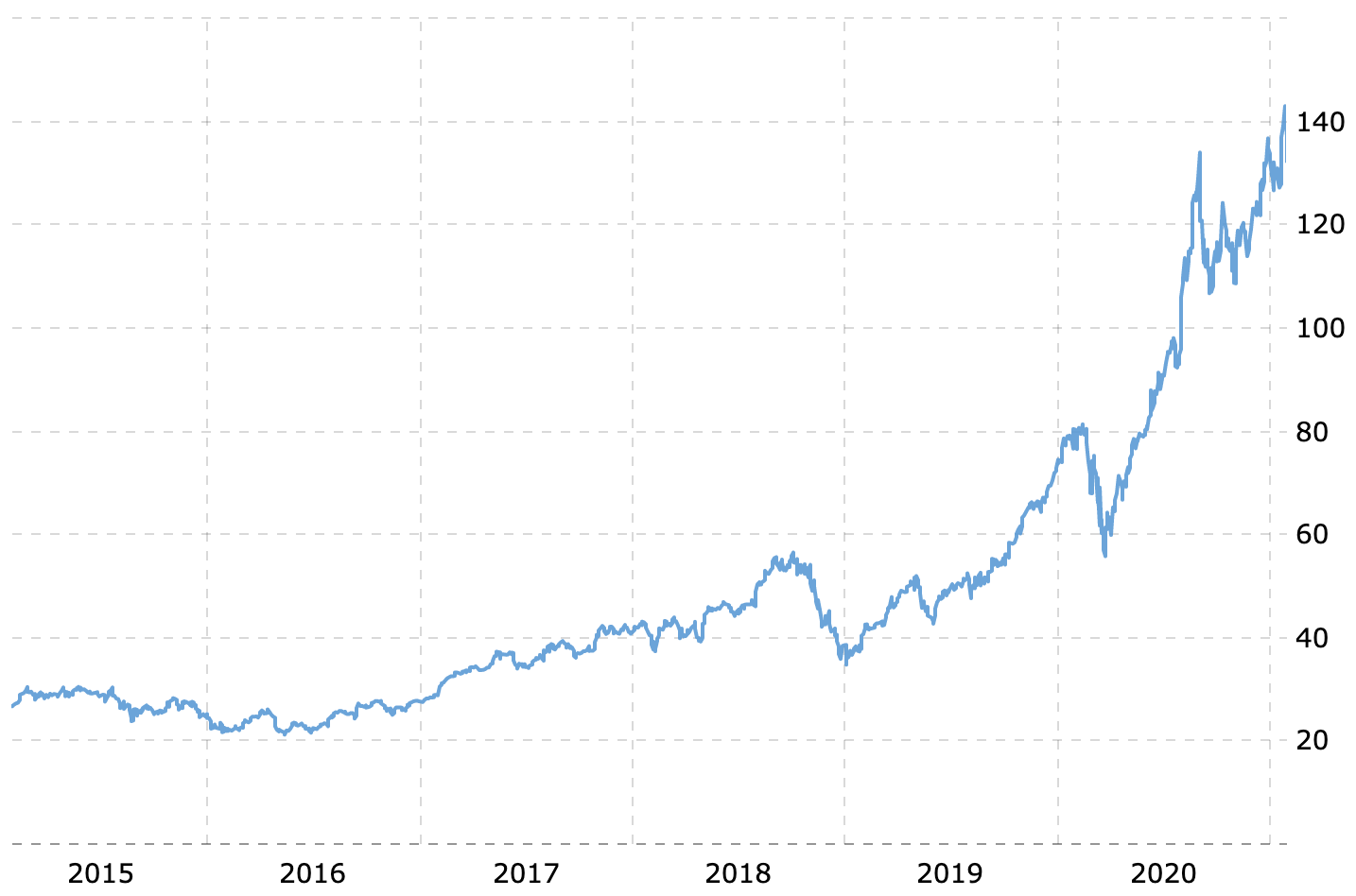
Apple Stock Price since 2015
Jan 2021
Takashi Idobe
Apple invented protocol-oriented programming:
Protocol Oriented Programming in Swift
by Dave Abrahams
I watched a video today on Swift … about ‘protocol oriented programming’ … and they basically just introduced typeclasses and they were like ‘We invented this, it’s amazing’
Haskell from 1988
Swift in 2018
If you’re 30 years late, you must be the first to implement it
Apple has great marketing
What does this print out in go?
FAIL: cannot use a (type int) as type float64 in argument to math.Min
I’ve never said that these types were addable.
class Shape a where
  name :: a -> String
  area :: a -> Float
  perimeter :: a -> Float

data Circle = Circle {r :: Float}
data Rectangle = Rectangle {w :: Float, h :: Float}

instance Shape Circle where
  name (Circle _) = "Circle"
  area (Circle r) = pi * r ^ 2
  perimeter (Circle r) = 2 * pi * r

instance Shape Rectangle where
  name (Rectangle _ _) = "Rectangle"
  area (Rectangle w h) = w * h
  perimeter (Rectangle w h) = 2 * w * 2 * h

printArea :: Shape a => a -> IO()
printArea s = putStrLn("My area is: " ++ show (area s) ++ "\n")

main = do
  printArea $ Circle 10
printArea $ Rectangle 10 20protocol Shape {
func name() -> String;
func area() -> Float;
func perimeter() -> Float;
}
struct Rectangle : Shape {
let l: Float;
let w: Float;
init(l: Float, w: Float) { self.l = l; self.w = w; }
func name() -> String { "Rectangle" }
func area() -> Float { l * w }
func perimeter() -> Float { 2 * (l * w) }
}
struct Circle : Shape {
let r: Float;
init(r: Float) { self.r = r; }
func name() -> String { "Circle" }
func area() -> Float { r * r * Float.pi }
func perimeter() -> Float { 2 * Float.pi * r }
}
func print_area(s: Shape) { print(s.get_area()) }
func main() {
print_area(s: Circle(r: 10))
print_area(s: Rectangle(l: 10, w: 20))
}use std::fmt::Debug;
trait Shape {
fn get_name(&self) -> String;
fn get_area(&self) -> f32;
fn get_perimeter(&self) -> f32;
}
#[derive(Debug)]
struct Circle {
r: f32,
name: String,
}
impl Circle {
fn new(r: f32) -> Circle {
Circle {
r,
name: "Circle".to_string(),
}
}
}
impl Shape for Circle {
fn get_name(&self) -> String {
self.name.clone()
}
fn get_area(&self) -> f32 {
self.r * self.r * 3.14
}
fn get_perimeter(&self) -> f32 {
self.r * 2.0 * 3.14
}
}
#[derive(Debug)]
struct Rectangle {
l: f32,
w: f32,
name: String,
}
impl Rectangle {
fn new(l: f32, w: f32) -> Rectangle {
Rectangle {
l,
w,
name: "Rectangle".to_string(),
}
}
}
impl Shape for Rectangle {
fn get_name(&self) -> String {
self.name.clone()
}
fn get_area(&self) -> f32 {
self.l * self.w
}
fn get_perimeter(&self) -> f32 {
(self.l + self.w) * 2.0
}
}
fn print_area<T>(t: T)
where
T: Shape + Debug,
{
println!("{:?}", t);
}
fn main() {
let circle = Circle::new(10.0);
println!("{}", circle.get_perimeter());
let rectangle = Rectangle::new(10.0, 20.0);
println!("{}", rectangle.get_perimeter());
print_area(rectangle);
print_area(circle);
}#include <iostream>
#include <string>
class Shape {
public:
virtual std::string getName() = 0;
virtual double getPerimeter() = 0;
virtual double getArea() = 0;
private:
std::string name_ = "Shape";
};
class Rectangle : public Shape {
public:
Rectangle(double l, double w) : l_(l), w_(w) {}
std::string getName() { return name_; }
double getPerimeter() { return 2 * (l_ + w_); }
double getArea() { return l_ * w_; }
private:
std::string name_ = "Rectangle";
double l_;
double w_;
};
class Circle : public Shape {
public:
Circle(double r) : r_(r) {}
std::string getName() { return name_; }
double getPerimeter() { return 2 * r_ * 3.14; }
double getArea() { return r_ * r_ * 3.14; }
private:
std::string name_ = "Circle";
double r_;
};
void printArea(Shape &shape) { std::cout << shape.getArea() << std::endl; }
int main() {
Rectangle r = Rectangle(10, 20);
Circle c = Circle(10.0);
printArea(c);
printArea(r);
}#include <stdio.h>
enum Shape_Type { CIRCLE, RECTANGLE };
struct Shape {
enum Shape_Type shape_type;
union {
struct {
double l;
double w;
};
struct {
double r;
};
};
char *(*getName)(struct Shape);
double (*getArea)(struct Shape);
double (*getPerimeter)(struct Shape);
};
char *getName(struct Shape s) {
if (s.shape_type == CIRCLE)
return "Circle";
else if (s.shape_type == RECTANGLE)
return "Rectangle";
else
return "Shape";
}
double getArea(struct Shape s) {
if (s.shape_type == CIRCLE)
return s.r * s.r * 3.14;
else if (s.shape_type == RECTANGLE)
return (s.l + s.w) * 2;
return 0;
}
double getPerimeter(struct Shape s) {
if (s.shape_type == CIRCLE)
return s.r * 2 * 3.14;
else if (s.shape_type == RECTANGLE)
return s.l * s.w;
return 0;
}
struct Shape makeShape() {
struct Shape s = {
.getName = getName, .getArea = getArea, .getPerimeter = getPerimeter};
return s;
}
struct Shape makeCircle(double r) {
struct Shape c = makeShape();
c.shape_type = CIRCLE;
c.r = r;
return c;
}
struct Shape makeRectangle(double l, double w) {
struct Shape r = makeShape();
r.shape_type = RECTANGLE;
r.l = l;
r.w = w;
return r;
}
int main() {
struct Shape c = makeCircle(10);
printf("My perimeter is: %f\n", c.getPerimeter(c));
printf("My area is: %f\n", c.getArea(c));
printf("My name is: %s\n", c.getName(c));
struct Shape r = makeRectangle(20, 40);
printf("My perimeter is: %f\n", r.getPerimeter(r));
printf("My area is: %f\n", r.getArea(r));
printf("My name is: %s\n", r.getName(r));
}Genealogically, OCaml comes from the line of programming languages whose grandfather is Lisp and includes modern languages such as Clojure, F#, Haskell, and Racket. Functional languages have a surprising tendency to predict the future of more mainstream languages. Java brought garbage collection into the mainstream in 1995; Lisp had it in 1958. Java didn’t have generics until version 5 in 2004; the ML family had it in 1990.
First-class functions and type inference have been incorporated into mainstream languages like Java, C#, and C++ over the last 10 years, long after functional languages introduced them. By studying functional programming, you get a taste of what might be coming down the pipe next. Who knows what it might be? (My bet would be pattern matching.)